
For those new to the sport, learning beginner boxing combos is an essential step in developing your skills in the ring.
This article introduces a series of beginner-friendly combos, each designed to build on the last, enhancing your technique, rhythm, and understanding of the sport.
Here’s what we’ll cover:
- Jab-Cross (1-2)
- Jab-Cross-Hook (1-2-3)
- Jab-Cross-Upper Cut (1-2-5)
- Jab-Cross-Body Hook (1-2-3b)
- Double Jab-Cross (1-1-2)
- Jab-Overhand Right (1-4)
- Cross-Lead Hook-Cross (2-3-2)
- Jab-Cross-Hook-Upper Cut (1-2-3-6)
Table of Contents
Jab-Cross (1-2)
The Jab-Cross combo is a cornerstone of boxing combinations.
It combines the most basic yet essential punches: the jab and the cross.
This combination is fundamental for improving your understanding of establishing range and creating openings.
A step-by-step breakdown:
- Stance: Begin in a boxing stance. If you’re right-handed, your left foot should be forward (and vice versa for left-handed boxers). Keep your weight balanced and your knees slightly bent.
- Jab (Lead Hand): Extend your lead hand straight forward, rotating your fist so your palm faces down at full extension. Snap your hand back quickly to guard (your cheek).
- Cross (Rear Hand): Immediately following the jab movement, throw a cross by extending your rear hand straight forward. Rotate your rear foot, hip, and shoulder into the punch for power.
- Return to Guard: Quickly bring your rear hand back to protect your face.
Key points to remember:
- Keep your guard up: Protect your face with your rear hand when throwing the jab and your lead hand when throwing the cross—your non-punching hand should always be protecting your chin.

- Breathe out with each punch: Exhale sharply with each strike to create power.
- Stay balanced: Distribute your weight evenly and stay on the balls of your feet to quickly move out of range of your opponent.
A few extra tips for this combo:
- Start slow: Focus on form and gradually increase speed.
- Use a mirror: Practice in front of a mirror to observe and correct your technique.
- Shadow boxing: Begin with shadow boxing to get comfortable with the combo before practicing on a bag or with a partner.
With the Jab-Cross sorted, you’ll have a solid foundation to build more complex combinations.
Jab-Cross-Hook (1-2-3)
Building on the Jab-Cross, adding the Hook introduces a powerful and often hidden punch to the combination.
This combo is excellent for varying your assault and can be particularly effective when in close range (“in the pocket”) with the opponent, as they often won’t see this punch coming.
A step-by-step breakdown:
- Stance: Start in your basic boxing stance, weight evenly distributed, and knees slightly bent.
- Jab (Lead Hand): Quickly extend your lead hand for the jab, rotating the fist so the palm faces down, and then snap it back to guard.
- Cross (Rear Hand): Follow with a cross, turning your rear foot and hip to add power.
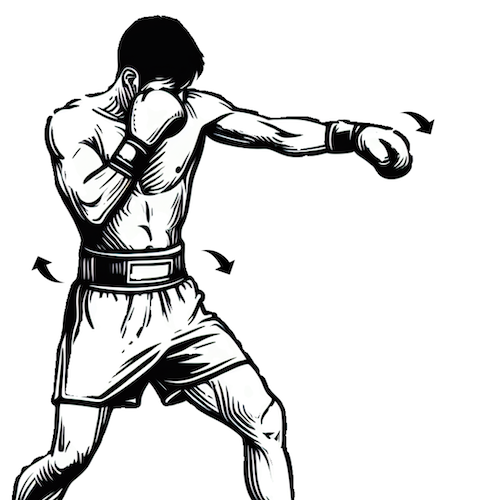
- Hook (Lead Hand): Pivot on your lead foot and rotate your body, bringing your Rear Hand Cross back to guard, swinging your lead hand in a horizontal arc towards the target. Keep your elbow bent at a 90-degree angle.
- Return to Guard: Quickly return to your boxing stance with your hands up to protect your face.
Key points to remember:
- Rotate your hips: Power in the hook comes from the rotation of your hips, not your arm. The arm simply makes the shape to deliver the impact.
- Keep your elbow parallel to the ground: This helps in delivering a powerful hook while keeping your joints safer from the impact.
- Guard your face: Always keep your other hand up to protect your face, especially when throwing the hook.
Extra tips for this combo:
- Focus on form: Start light and focus on your form, the repetition and power of this punch can lead to injuries in your Serratus Anterior, elbow, and wrist if performed with too much power and not enough quality.
- Practice on the heavy bag: Once you’ve got the movement pattern down, practice this combo on the bag regularly.
Mastering the Jab-Cross-Hook combo will add a hefty power punch to your toolset.
Jab-Cross-Upper Cut (1-2-5)
Adding an uppercut after the Jab-Cross is an alternative to the hook and helps to mix up your attacks.
It can be very effective at close range and often splits open the opponent’s guard, coming outside of their peripheral vision.
A step-by-step breakdown:
- Stance: Maintain your standard boxing stance with balanced weight and knees slightly bent.
- Jab (Lead Hand): Execute a quick jab by extending your lead hand and rotating the fist, then retract to guard.
- Cross (Rear Hand): Follow with a cross, turning your rear foot and hip for power, then bring your hand back to guard.
- Upper Cut (Lead Hand): Drop your lead hand slightly and bend your knees. Then, drive up through your legs and hips, thrusting your lead hand upward towards their chin.
- Return to Guard: Quickly return to your boxing stance, hands up to protect your face.
Key points to remember:
- Use your legs: Power in the uppercut comes from your legs and hips, it generates all the force!
- Keep it tight: The uppercut should still be holding the arm close to your body to increase power but also make returning to protection faster.

A couple of extra tips for this combo:
- Start with shadow boxing: Practice the movement without power to get the form down, this one can be really difficult to get right.
- Work with a coach: It’s trickier to practice this punch without a coach, as you’ll need them to hold the pad to train the form.
The Jab-Cross-Upper Cut is a classic surprise punch for your opponent, but it can be one of the riskiest to use as it can leave you wide open for a counter cross.
Jab-Cross-Body Hook (1-2-3b)
The Jab-Cross-Body Hook combo introduces an attack on the body of your opponent.
This will expand your target points and can add devastating hits to disorientate your opponent.
A combo that combines head and body attacks, which can be especially useful in wearing down an opponent’s defenses, encouraging them to drop the arms to protect the body and open up the head.
A step-by-step breakdown:
- Stance: Begin in your boxing stance, with your weight balanced and knees flexed.
- Jab (Lead Hand): Execute a sharp jab, extending your lead hand and rotating your fist, then quickly retracting to guard.
- Cross (Rear Hand): Immediately follow with a cross, turning your rear foot and hip for added power, then return your hand to guard.
- Body Hook (Lead Hand): Shift your weight slightly to your rear leg, pivoting on your lead foot, and rotate your torso to swing your lead hand towards the opponent’s body. Keep your arm parallel to the ground with the elbow bent.
- Return to Guard: Come back to your original boxing stance with your hands up to protect your face.
Key points to remember:
- Aiming for the liver shot: Give a slight upward angling to the punch while aiming just underneath the opponent’s ribs to send shockwaves through to the liver.
- Pivot for power: Use your lead foot and hip pivot to generate power for the body hook.

Extra tips for this combo:
- Practice the pivot: Work on the pivoting motion for the body hook, slightly leaning back makes the movement work.
- Balance is key: Maintain good balance throughout the combo, especially when shifting weight for the body hook.
This Jab-Cross-Body Hook extends your options by attacking the body and making your opponent constantly think about defending them.
Double Jab-Cross (1-1-2)
The Double Jab-Cross combo is a great way to improve rhythm and timing in your boxing technique while opening up the opponent’s guard by encouraging them to parry.
Doubling up on the jab adds that extra element of unpredictability to confuse them.
A step-by-step breakdown:
- Stance: Start in a balanced boxing stance, with your weight evenly distributed and knees slightly bent.
- First Jab (Lead Hand): Quickly extend your lead hand for the first jab, rotating your fist and snapping it back to guard.
- Second Jab (Lead Hand): Immediately follow with a second jab. Occasionally it’s OK to deliver it immediately after the first jab, to increase the speed of delivery, but could leave you more open to a counter.
- Cross (Rear Hand): Complete the combo with a powerful cross, turning your rear foot and hip to add force and follow through to get maximum impact.
- Return to Guard: Bring both hands back up to protect your face.
Key points to remember:
- Vary the jabs: Change the speed or power between the first and second jabs to create a pattern that’s harder to predict.
- Footwork: Keep moving between jabs to maintain a dynamic distance, side-stepping, advancing, or even retreating.
A few extra tips for this combo:
- Rhythm practice: Work with a metronome or rhythm trainer app to develop your own pattern, then work on varying it to become unpredictable
- Light or technical sparring: Try this combo in light sparring sessions to get a feel for its effectiveness against a moving opponent.
The Double Jab-Cross is an excellent way to keep your opponent guessing and to set up a powerful punch that you can change as you gain more confidence.
Jab-Overhand Right (1-4)
The Jab-Overhand Right combo introduces a powerful and deceptive punch that has consistently delivered knockouts for boxing professionals and MMA fighters alike.
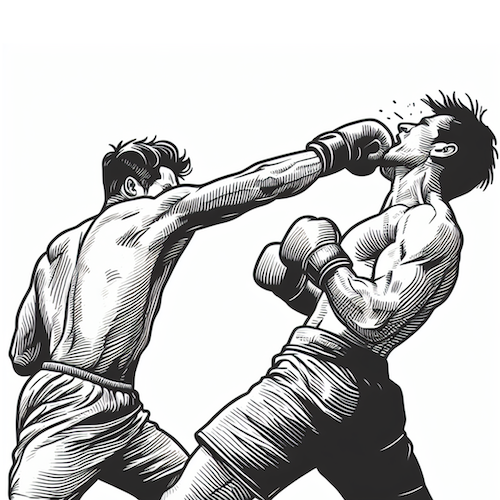
The overhand right is thrown over the top while lowering your head.
It can be really useful against a taller opponent or getting a power punch over and around their lead hand’s guard. I LOVE this punch!
A step-by-step breakdown:
- Stance: Assume your standard boxing stance which should be balanced and ready.
- Jab (Lead Hand): Start with a quick jab, extending your lead hand and snapping it back to the guard to create an opening.
- Overhand Right (Rear Hand): Instead of a straight cross, throw an overhand right. Bend your knees more to drop your head and overall level, and swing your rear hand over at a 2 o’clock position to get over their guard.
- Return to Guard: Quickly bring your hands back up to protect your face and be prepared to move backward avoiding any counters.
Key points to remember:
- Protect your chin: Keep your lead hand up to protect your chin as you throw the overhand right to have defenses against a check hook.
- Confuse then deliver: This combo is best used after varying up your striking on an opponent with jab variety and bodywork, as it’s more likely to land as dropping your level makes them expect a body attack, dropping their guard further.
A few extra tips for this combo:
- Dropping your level: Practice the movement regularly to drop your level fast both on delivery and retreat, it’s important to get your head out of the way!
- Fake it ’til you make it: This combo gets even better when faking the jab to the head. Fake Jab to the head, jab the body, then deliver the overhand.
The Jab-Overhand Right is a necessary tool when dealing with taller foes, if you’re shorter for your weight then perfecting this combo is vital.
Cross-Lead Hook-Cross (2-3-2)
The Cross-Lead Hook-Cross combo allows for aggressive counter-attacking of the opponent’s advance or simply punishing a weak defense.
It starts with the power punch (cross), follows with a quick lead hook, and finishes with another cross, making it ideal for exploiting openings.
A step-by-step breakdown:
- Stance: Begin in your standard boxing stance, with a focus on balance and readiness.
- First Cross (Rear Hand): Launch a powerful cross, turning your rear foot and hip to drive the punch.
- Lead Hook (Lead Hand): Immediately follow with a lead hook. Pivot on your lead foot and use your torso to generate power, keeping your elbow bent.
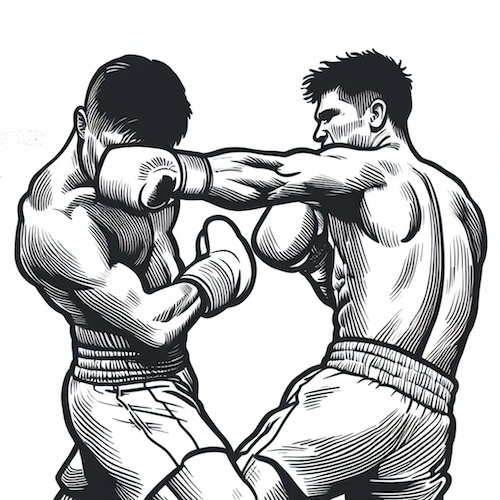
- Second Cross (Rear Hand): Finish the combo with another cross, using the momentum from your hook to deliver in a rhythmic way.
- Return to Guard: Quickly bring your hands back up to protect your face.
Key points to remember:
- Fluid motion: Ensure smooth transitions between each punch.
- Stay upright: This is a combination with a high likelihood of return fire, be prepared to slip the opponent’s responses and stay balanced.
- Don’t overextend: Keep your punches controlled, we want power but do not move yourself into the line of fire.
More combo tips:
- Power variety: Change up which punch you will throw all your power into and mix it up. Speed-Speed-Power isn’t the only option, try Power-Speed-Speed, etc.
- Switch stance: Try advancing into one of your crosses by stepping through with your rear foot, landing you in a switch stance (e.g. orthodox to southpaw), completely changing your attacking options.
The Cross-Lead Hook-Cross combo is an assertive tool for creating offensive pressure.
Jab-Cross-Hook-Upper Cut (1-2-3-6)
Let’s finish off the combinations by pulling together several of the punches we’ve learned.
The Jab-Cross-Hook-Upper Cut combo is a comprehensive sequence that combines straight punches with hooks and uppercuts, offering a full range of attack angles to dazzle your opponent.
This combo is effective in keeping them on the defensive.
A step-by-step breakdown:
- Stance: Start in your balanced boxing stance, ready for movement.
- Jab (Lead Hand): Begin with a sharp jab, extending your lead hand swiftly and retracting it quickly to guard.
- Cross (Rear Hand): Follow up with a cross, turning your rear foot and hip to add power.
- Hook (Lead Hand): Pivot on your lead foot and rotate your torso to deliver a lead hook with your elbow bent.
- Upper Cut (Rear Hand): Finish with an uppercut. Drop your rear hand slightly and drive upward with your rear hip.
- Return to Guard: Resume your boxing stance with your hands up to protect your face.
A couple of key points:
- One hand after the other: This combination is simple to deliver since it’s Lead-Rear-Lead-Rear with your hands, or if you’re orthodox that’s Left-Right-Left-Right—allowing for tempo.
- Fluidity: It’s another combo that performs best in fluidity, we’re not aiming for power but for mixing up the angles of attack.

Extra tips to know:
- Rhythmic drilling: Practice the combo with a focus on rhythm to build muscle memory.
- Bag and pad work: Train this combo on both heavy bags and with pad holders to fine-tune the cadence and delivery.
Getting the Jab-Cross-Hook-Upper Cut combo down will be the start of entering much more advanced techniques, so practice it consistently along with all the combos listed in this article.
You’ll become a pro in no time.
Master the fundamentals of boxing (with 25% off!)
MMA Hive readers get 25% off the Boxing Fundamentals Course by Day One Martial Arts. Use code MMAHIVE:
90-page instructional ebook
EVERYTHING a beginner boxer needs to know
24 boxing video workouts
16 hours+ of videos to train at home whenever you want
200+ guided drills
Every fundamental boxing step, move and strike detailed
